Half-Day vs Full-Day
Yacht Charter Miami
The first real decision in chartering a yacht in Miami is not the vessel. It is how long you want to be on the water. Four hours and eight hours are different days, and the right call depends on why you are out there.
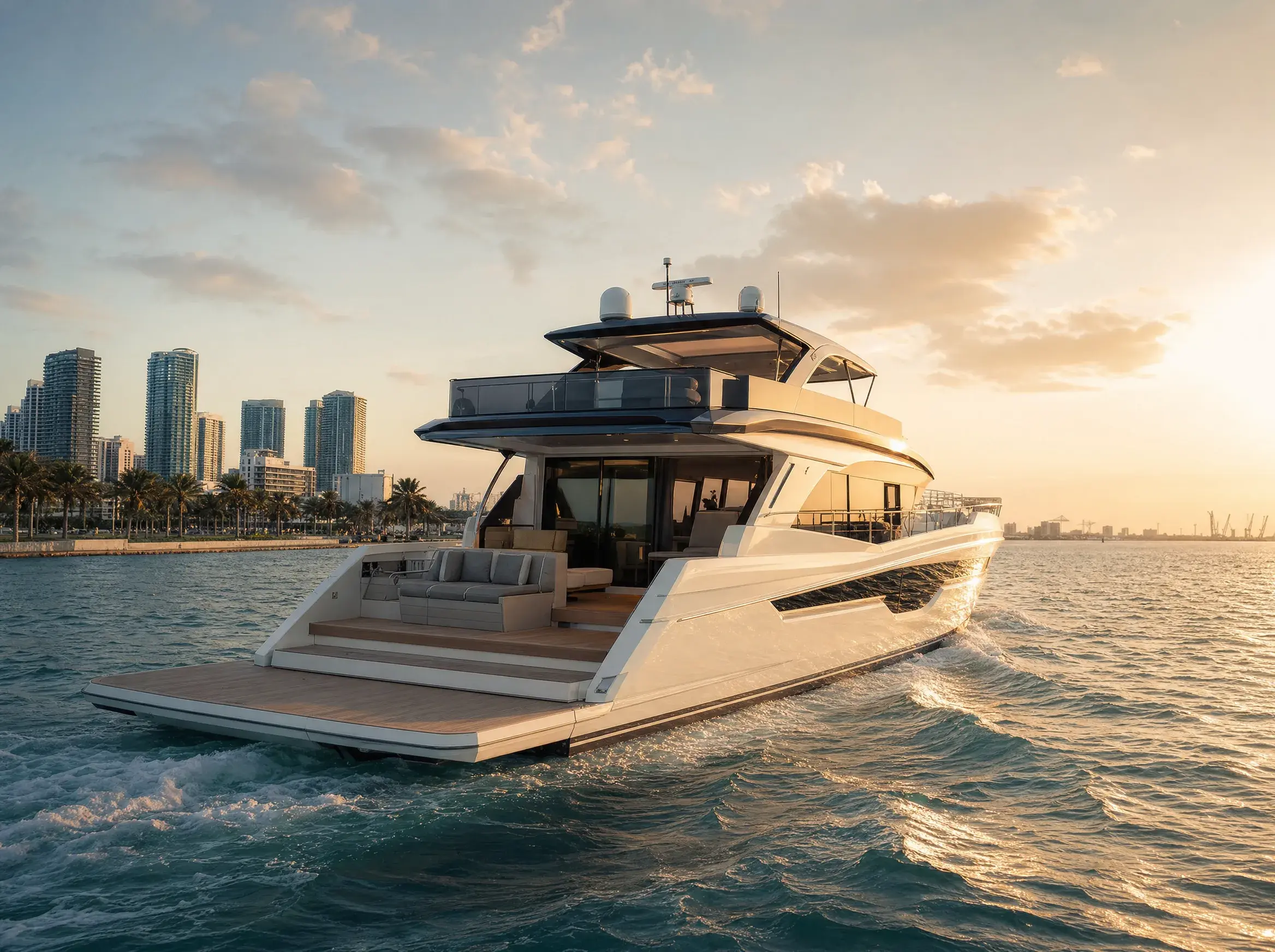
Almost every Miami yacht charter inquiry starts with the same question: half-day or full-day. The four-hour charter is the entry point in our catalog and the most-booked format, enough water time for a sandbar afternoon or a sunset loop without committing the whole day. The eight-hour charter is a different proposition. It turns the vessel from transport into the venue, opens up multi-stop itineraries the four-hour window cannot reach, and gives a group the kind of unhurried day that does not watch the clock. Neither is the better charter in the abstract. The right one depends on the occasion, the group, the weather, and how much of the day you actually want to spend on the water. This page lays out where each format wins, honestly, so the choice is made on the real trade-offs rather than on a guess.
Half-Day vs Full-Day At a Glance
When Half-Day Wins
The half-day wins when the day has a single, concentrated focus. A birthday lunch at the Key Biscayne sandbar, a proposal timed to a Star Island sunset, a first cruise for a couple in town for a weekend: these are four-hour occasions. The moment is the point, and stretching it to eight hours dilutes rather than improves it. The half-day also wins for first-time charterers who do not yet know how long they want to be on the water. Four hours is enough to find out, and a group that wishes it had more time can extend on a future booking with a clear sense of why. Weather-uncertain days favor the half-day too. A shorter commitment means a smaller cancellation or reschedule exposure if the marine forecast turns, and the captain has an easier time finding a clean four-hour window than a clean eight-hour one. And the half-day wins on pure sandbar intent: if the plan is to anchor at Haulover or Nixon's, swim, and come back, with no broader cruising ambition, four hours covers it completely. Families with young kids often land here as well, because four hours on the water is closer to a child's natural limit than eight.
When Full-Day Wins
The full-day wins when the boat is the venue, not the transport. Bachelor and bachelorette weekends, milestone celebrations, and group trips where the charter is the centerpiece of the day all need the eight-hour window, because the four-hour version ends just as the day finds its rhythm. The full-day also wins for content shoots and music video productions, where setup, lighting, and repositioning eat into the schedule before a single usable frame is shot; an eight-hour charter with a pre-boarding buffer is the realistic minimum for production work. Multi-stop itineraries are full-day territory by definition. A sandbar morning, an island cruise, and a sunset return cannot be compressed into four hours, and the captain needs the longer window to build a real route rather than a single anchor stop. The full-day is also the honest test for Bahamas-curious charterers. A group considering the Bimini crossing or an overnight can use a full-day local charter to learn how their group handles eight hours on the water before committing to the bigger trip. And for groups that simply do not want to watch the clock, the full-day removes the pacing pressure entirely.
The Verdict
Match the format to the occasion, not to the budget. A first-time charterer with eight guests for a birthday should book the half-day: the celebration is concentrated, the group is new to the water, and four hours at a sandbar with a cake and a swim is a complete day. A bachelor or bachelorette party of twelve for a Saturday in peak season should book the full-day without hesitation, because the boat is the venue and the four-hour version would end mid-afternoon with the group wanting more. A photoshoot or music video crew should book the full-day and add a pre-boarding buffer, since rigging and setup are non-trivial and the usable shooting window inside a four-hour charter is short. A couple planning a proposal should book the half-day and time it to sunset; the moment does not need eight hours around it. A family with young children usually wants the half-day, because four hours tracks a child's natural limit on the water. A corporate group entertaining clients can go either way: a three to four hour sunset cruise for a dinner, the full-day for a team outing with a sandbar stop. When the occasion genuinely has no single focus and the group wants an unhurried day, the full-day is the answer. When there is one clear moment the day is built around, the half-day protects it.
FAQs
Can I extend a half-day to a full-day on the same booking?
Sometimes, but not reliably on the day itself. If the vessel has no charter behind yours the captain may be able to extend at the standard hourly rate, but peak weekends are usually back-to-back. The safe move is to book the format you want up front. If you are unsure, book the half-day and plan a future full-day rather than counting on a same-day extension.
How much does food and beverage add to either format?
It scales with the format. A half-day usually runs on a cooler or a light catering pack, a modest add. A full-day more often involves a catered lunch or a chef onboard, which is a larger line item but spread across a longer day. Bar service and champagne are add-ons in both formats. The concierge quotes food and beverage separately so you see it clearly against the charter rate.
Does the captain change the route based on which format we pick?
Yes, substantially. A four-hour charter is built around a single anchor stop or a sunset loop, because that is what the window allows. An eight-hour charter lets the captain build a real multi-stop route: a sandbar morning, an island cruise, a sunset return. Tell the captain the format and the priorities at booking and the route is planned to fit.
What happens if weather changes mid-charter?
The captain has full discretion and will re-route to protected water if conditions turn. A half-day has less exposure simply because it is a shorter window. On a full-day the captain may shift the order of the itinerary, swap an open-water leg for a bay route, or adjust timing. In either format, if conditions make the charter unsafe the captain calls it, and the rebooking terms are confirmed in writing at the time of booking.